
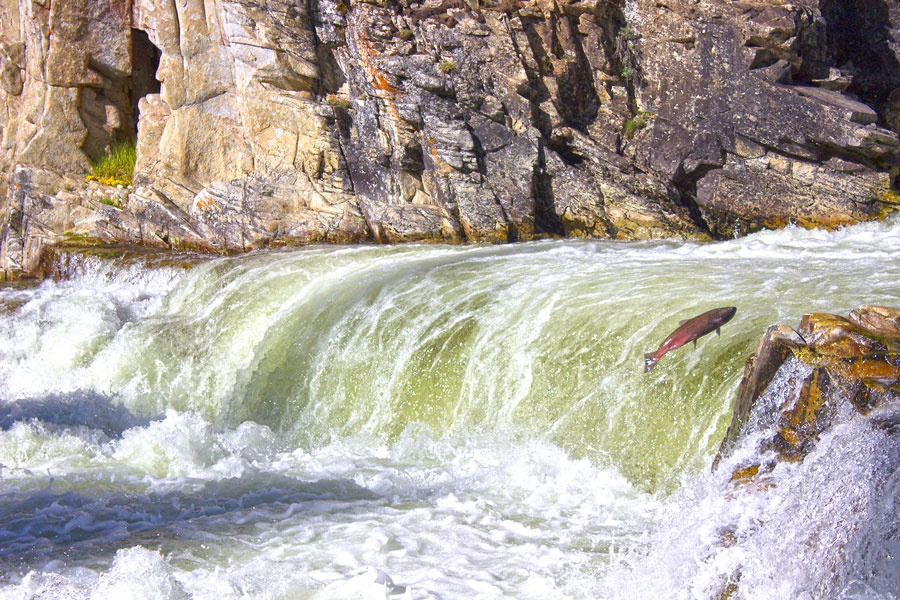
Idaho Outfitters and Guides are working to restore salmon and steelhead runs to Idaho's Snake River Basin.
Idaho has three species of native, wild, sea-run (all the way to the Pacific and back!) salmonids: sockeye, Chinook, and steelhead trout. Coho were reintroduced to Idaho in the 1990s from Lower Columbia stocks after being extirpated in 1986. Historically, the Snake River Basin was one of the most productive salmon and steelhead watersheds in the world, spawning millions of Chinook, Sockeye, Coho and steelhead every year. Idaho's salmon and steelhead populated watersheds from the temperate rainforests of the Clearwater to the high alpine valleys of the Salmon to the sagebrush deserts of the Owyhee, Bruneau, and Jarbridge Rivers. During their upstream migrations, they turned the rivers silver and red, and brought vast and priceless quantities of marine nutrients to inland ecosystems. Since time immemorial, indigenous tribes in the Pacific Northwest stewarded these salmon runs, relying on them for both physical and cultural nourishment.
In the 20th Century, the Army Corps of Engineers built eight massive dams on the Lower Snake and Columbia Rivers. These dams were intended to provide electricity, barge transportation, and ultimately economic development to the Pacific Northwest. Now, they drain public dollars, strangle river economies, and drive our salmon and steelhead to extinction. The four dams on the Lower Snake River are particularly noxious – decimating salmon runs from the most productive rivers left in the Lower 48.
Despite their soaring economic and environmental costs, dam proponents continue to spread misinformation, claiming the Lower Snake River Dams are necessary to grain and energy markets. In reality, the heavily-subsidized barge transportation is in steep decline, and the energy produced by the dams is limited, environmentally damaging, and increasingly uncompetitive.
Our livelihood and our communities rely on these keystone species, and we have seen over and over again how declining runs hurt rural Idaho river towns. We also understand our responsibility as guides to steward and protect the ecosystems we draw so much from.
We have the science, the technology, and the resources to retire the Lower Snake River dams, replace their services, and restore the Snake River Basin. All we lack is the political will to undertake the greatest river restoration in history.
Learn the essentials!
Expand each panel for more information.
Quick & Dirty
Idaho’s salmon and steelhead story can be summed up simply, but the implications are massive. For thousands of years, millions of wild salmon returned from the Pacific Ocean to Idaho’s headwaters, swimming farther and higher than any salmon in the world. These runs were the foundation of ecosystems, Tribal cultures, and eventually small-town economies. Today, those returns are only a shadow of what they once were. In many years, fewer than 30,000 wild salmon and steelhead make it back to Idaho — a collapse of more than 95%.
The main reason for this decline is no mystery. Scientists across agencies, universities, and independent panels agree that the four federal dams on the Lower Snake River are the largest human-caused source of mortality for Idaho’s fish. Every juvenile salmon and steelhead born in Idaho must pass through eight dams and reservoirs before reaching the ocean. For the healthiest, most resilient rivers in central Idaho — places like the Middle Fork Salmon or Selway — survival through natural habitat is relatively strong. But once smolts hit the slackwater of the Lower Snake, mortality skyrockets. Dams create slow, warm reservoirs that disorient fish, attract predators, and stress smolts before they even reach the ocean. Turbines, bypass systems, and spillways add further lethal pressure. The result: survival rates from smolt to adult are far too low to sustain healthy, fishable runs.
The simple truth is that unless these dams are addressed, Idaho’s salmon and steelhead will remain on a path toward extinction. Hatcheries have provided stopgap support, keeping runs from disappearing entirely, but hatchery fish are not a substitute for self-sustaining wild populations. They mask the underlying collapse and often confuse the public into thinking things are better than they are.
The good news is that dam services — hydropower, freight, and irrigation — can be replaced. Studies by federal agencies, the Northwest Power and Conservation Council, and outside experts confirm that energy from the dams is relatively modest, seasonal, and replaceable with clean resources. Barge freight can transition to rail and truck with infrastructure upgrades. Irrigation pumps can be modified to keep farm water flowing. These solutions require investment, but they are achievable and already proven in other river systems like the Klamath and Elwha.
For Idaho outfitters and guides, the stakes are immediate. Every lost run means fewer bookings, fewer jobs, and fewer opportunities for clients to experience the magic of Idaho’s rivers. The “quick and dirty” story is the same one your clients, legislators, and neighbors need to hear: the choice is between continuing with a failed status quo or restoring the greatest salmon and steelhead runs on earth by removing barriers that no longer serve us as well as they once did.
Species & Status
Idaho is home to some of the most iconic salmonid species in the world, each with a unique story and role in our rivers. Sockeye, Chinook, and steelhead are the native anadromous species — fish that migrate from mountain streams to the ocean and back. Coho, once extirpated, have been reintroduced. Together, these species define much of the natural and cultural heritage of the state.
Sockeye Salmon are perhaps the most endangered. Once numbering in the tens of thousands, they returned in such abundance to Redfish Lake that the waters glowed red with spawning fish. Today, most years see only a handful of natural-origin sockeye return. In 1992, Snake River sockeye were listed as endangered under the Endangered Species Act. Intensive hatchery programs and the work of the Shoshone-Bannock Tribes have kept them from vanishing entirely, but truly wild sockeye remain on the brink.
Chinook Salmon are central to Idaho’s economy and identity. There are two primary groups: spring/summer Chinook and fall Chinook. The spring/summer runs historically migrated deep into Idaho’s wilderness headwaters, powering rural river economies in places like Riggins, Salmon, and Stanley. To sustain viable fisheries, Chinook need smolt-to-adult return rates (SARs) of at least 2–6%. In most years, SARs are below 1%, meaning populations are in long-term decline despite hatchery releases.
Steelhead, a sea-run rainbow trout, are beloved by anglers across Idaho and the Northwest. They are known for their strength, resilience, and unpredictable runs. However, steelhead face the same dam-related mortality as salmon, and recent years have seen unprecedented closures. The 2019 closure on the Clearwater River — costing an estimated $8.6 million per month in lost revenue — illustrates just how fragile these populations are and how critical they are to river communities.
Coho Salmon were declared extinct in Idaho by the 1980s, but efforts by the Nez Perce Tribe have reintroduced coho to the Clearwater Basin. Returns are modest, but they offer hope that restoration is possible with the right management and Tribal leadership.
Beyond their cultural and recreational value, these fish are ecological keystones. More than 130 species rely on the nutrients salmon bring back from the ocean — everything from eagles to bears to streamside forests. The decline of salmon has cascading effects across ecosystems.
For outfitters and guides, knowing these species and their status is more than trivia. It is the backbone of your story to clients: Idaho rivers once hosted millions of salmon and steelhead, and with bold action, they can again. Sharing the history, the science, and the urgent need for restoration helps turn a day on the river into a call to action.
Lower Snake Dams & Replacements
The four federal dams on the Lower Snake River — Ice Harbor, Lower Monumental, Little Goose, and Lower Granite — were built between the 1950s and 1970s. Their purpose was to provide hydropower, barge transportation, and irrigation support to parts of the inland Northwest. For decades, these projects were hailed as feats of modern engineering. But as the decades passed, the costs — both financial and ecological — have became impossible to ignore, especially in Idaho where the survival of salmon and steelhead hinges on safe passage through this system.
Each dam creates a reservoir that slows and warms the river, turning a once-free-flowing corridor into nearly 140 miles of slackwater. Juvenile salmon and steelhead migrating downstream are forced to pass through turbines, spillways, or bypass systems at each dam, with mortality accumulating along the way. Smolt survival through the four dams and reservoirs can be less than 50%, far below what is needed to sustain wild populations. Adults returning to spawn face their own gauntlet of hot water and difficult passage. The result is a survival bottleneck unique to Idaho’s fish: even pristine habitat in the Salmon, Selway, and Middle Fork cannot offset the mortality imposed by the Lower Snake.
The services provided by the dams are real, but they are replaceable. Hydropower output from the four projects averages about 700 megawatts annually — a fraction of the Northwest’s overall portfolio. Multiple analyses show that wind, solar, storage, and transmission upgrades can more than offset this output while improving grid reliability and meeting clean-energy goals. Barge freight, once the main justification for keeping the dams, has been declining for decades. Today, only a small portion of Idaho grain moves by barge, and investments in rail and highway infrastructure can replace this service at modest cost. Irrigation is the third service, primarily tied to pumps on Ice Harbor Reservoir. Engineering solutions already exist to maintain water access if reservoirs are drawn down, keeping farms viable without trapping fish behind slackwater.
Critics of dam removal often present it as a radical or impossible solution. In reality, the U.S. has already removed more than 1,200 dams in the last two decades. The Klamath, Elwha, and White Salmon projects demonstrate how carefully planned removals can revitalize ecosystems, protect communities, and replace services. The Lower Snake represents a larger scale, but not a new concept. Tribes, conservationists, utilities, and communities are already collaborating to envision what service replacement would look like in practice.
For Idaho outfitters and guides, the dam issue is not an abstract debate. It determines whether future generations will know Idaho as a place of world-class salmon and steelhead fishing, or as a place where those species exist only in memory and hatchery tanks. The path forward is clear: replace the dams’ services, restore a free-flowing Lower Snake, and give Idaho’s fish a real chance at recovery.
Economic Importance
Salmon and steelhead are not only ecological keystones but also economic engines for Idaho. Their return each year sustains a vast web of businesses, from outfitters and guides to hotels, restaurants, and gear shops. The economic value of these fish is often underestimated, but the numbers tell a powerful story.
Sportfishing generates about $1.2 billion annually in Idaho, supporting an estimated 8,750 jobs. These are not abstract figures — they represent paychecks in rural towns, tax revenue for schools, and the lifeblood of communities that depend on seasonal recreation. For many places, fishing is as central to the economy as agriculture or forestry.
The 2001 spring Chinook season offers a vivid example. That year, Idaho saw one of its better returns in recent history, and anglers responded in force. Economic studies found that the season generated $107 million in spending across the state, with nearly half — about $51 million — concentrated in river towns like Riggins, Orofino, and Lewiston. For small communities, that infusion of cash was transformative. Motels were booked, cafes stayed open late, and guides reported their busiest seasons in memory.
The flip side of abundance is scarcity, and closures demonstrate just how much communities lose when fish runs fail. In 2019, a steelhead closure on the Clearwater River forced outfitters to cancel trips and towns to weather empty seasons. The estimated losses were staggering: $8.6 million per month, totaling $34.4 million over four months. For small towns, those losses meant shuttered storefronts, guides struggling to make mortgage payments, and ripple effects across entire counties.
The guiding industry has a multiplier effect that goes beyond direct spending. For every salmon or steelhead guide working in Idaho, an estimated 2.1 additional jobs are supported in the community. That might be a hotel clerk, a waitress, a shuttle driver, or a fly-shop employee. When runs collapse, the damage is not limited to guides; it reverberates across the local economy.
Looking long-term, restored salmon and steelhead runs could generate sustained prosperity. Analyses suggest that with healthy, harvestable populations, fishing could return to being one of Idaho’s largest renewable economic sectors. Instead of boom-and-bust cycles tied to unpredictable runs, towns could rely on stable seasons that attract both resident and nonresident anglers.
For policymakers, the lesson is clear: investing in salmon recovery is not just an environmental issue, it is an economic one. The cost of replacing dam services must be weighed against the enormous value of restored fisheries. For outfitters and guides, this is about more than dollars — it is about sustaining a way of life and a profession rooted in Idaho’s rivers. Every lost season is a reminder that the status quo is failing not only fish but also communities. Recovery represents both ecological justice and economic common sense.
Tribal & Cultural Importance
For Columbia Basin Tribes, salmon are not just a species — they are a way of life. Since time immemorial, salmon have been at the heart of Tribal culture, spirituality, and sustenance. Treaties signed with the U.S. government in the mid-1800s, such as the Treaty of 1855, guaranteed Tribes the right to fish “at all usual and accustomed places.” These rights were not granted, but reserved — an acknowledgment of inherent sovereignty. Today, the continued decline of salmon represents not just an ecological crisis, but a breach of those commitments.
Tribal leaders have long articulated the cultural and spiritual significance of salmon. The First Salmon ceremony, practiced by many Tribes, symbolizes respect and reciprocity: by honoring the first fish of the season, communities reaffirm their responsibility to steward the resource. The disappearance of salmon from rivers once central to these traditions is a profound cultural loss that no compensation can replace.
Economically, the impact is also stark. Fishing rights were intended to provide food security and economic stability. Instead, many Tribal communities have faced declining harvests, loss of traditional diets, and disruption of cultural practices. The Yakama Nation, Nez Perce Tribe, Umatilla, and others have invested millions in hatcheries, habitat restoration, and legal battles simply to maintain minimal returns.
Yet, Tribal leadership is central to solutions. The Nez Perce Tribe has pioneered reintroduction of coho salmon in Idaho, showing that resilience is possible with the right approach. Tribes were key to advancing the Columbia Basin Fish Accords, securing funding for restoration projects. Today, Tribal governments are among the strongest advocates for Lower Snake River dam removal and service replacement, framing it as a matter of justice, survival, and honor.
For guides and outfitters, understanding this dimension is crucial. Many clients may not realize that salmon recovery is a Tribal rights issue as much as an environmental one. Sharing this story helps connect conservation with justice and respect for sovereign nations. By aligning with Tribal voices, outfitters and guides can strengthen advocacy, build partnerships, and show that restoring salmon is about honoring commitments that predate the state of Idaho itself.
Policy & Legal Context
The policy framework around salmon and steelhead is vast, but at its core are a few key laws and decisions. The Endangered Species Act (ESA) listings of the 1990s marked a turning point. Snake River sockeye, spring/summer Chinook, fall Chinook, and steelhead were all listed as threatened or endangered, triggering federal obligations to prevent extinction and promote recovery. Federal agencies, particularly the Bonneville Power Administration and U.S. Army Corps of Engineers, have been required to manage the hydrosystem consistent with ESA requirements.
Over the past three decades, litigation has driven much of the policy. Federal Biological Opinions (BiOps) on dam operations have been repeatedly struck down by the courts for failing to meet ESA standards. Judges have consistently recognized that the Lower Snake dams are a central barrier to recovery. This cycle of plan, lawsuit, and rejection has created uncertainty but also reinforced the urgency of real solutions.
The “four H’s” framework — habitat, hydropower, harvest, and hatcheries — remains the standard lens for salmon management. While improvements in harvest management and hatchery reform have been significant, the hydropower system continues to exert disproportionate mortality. Independent Scientific Advisory Boards and the Northwest Power and Conservation Council have confirmed that survival targets cannot be reached without addressing the Lower Snake bottleneck.
Recent developments add new weight. The 2023-2024 federal mediation between Tribes, states, and the Biden Administration resulted in commitments to invest in replacement power, transportation, and restoration planning. This signals a shift from debate toward implementation. Congressman Mike Simpson’s Columbia Basin Initiative (CBI) also reframed the conversation, proposing a $33 billion package to remove the dams and replace their services. While not yet adopted, it reset expectations about the scale of investment required.
For Idaho outfitters and guides, this policy context matters for two reasons. First, it highlights that the science is settled: the dams are the obstacle. Second, it shows that the conversation has moved from “if” to “how” replacement will occur. Guides can speak with authority that restoring salmon is not a fringe idea, but a federally recognized necessity supported by decades of law, science, and court rulings. This strengthens the credibility of advocacy and reinforces the alignment between economic survival and legal responsibility.
Case Study: Klamath
The Klamath River in Oregon and California offers the most relevant precedent for the Snake. For decades, four dams blocked salmon and steelhead runs, degraded water quality, and undermined Tribal rights. After years of conflict, Tribes, farmers, conservationists, and utilities negotiated the largest dam removal project in U.S. history. By 2023, removal of the first dams was underway, with full removal slated by 2025.
The Klamath case demonstrates several lessons. First, it shows that broad coalitions can succeed. The Yurok and Karuk Tribes, supported by commercial fishermen and environmental groups, worked with PacifiCorp (the utility owner) to craft a settlement that balanced interests. Second, it proved that service replacement is achievable. PacifiCorp invested in renewable energy portfolios and grid improvements, ensuring power reliability. Third, it showed how dam removal can catalyze ecological restoration. Sediments released into the river are expected to rebuild habitat, water quality is already improving, and salmon are expected to recolonize upstream reaches within years.
Financially, the Klamath project illustrates how costs can be shared. State bonds, federal funds, and private utility contributions all combined to cover expenses. This model could apply in the Snake Basin, where Bonneville Power, federal appropriations, and state/federal infrastructure funds could together cover replacement.
For Idaho, the Klamath proves that removing large dams is not a fantasy — it is happening now. The ecological and cultural parallels are strong: Tribes regaining access to ancestral fisheries, communities investing in alternatives, and a river given a new chance at life. Outfitters and guides can use the Klamath story to answer skeptics: yes, it can be done, and yes, it works.
Appendix: Simpson’s CBI
In 2021, Idaho Congressman Mike Simpson proposed the Columbia Basin Initiative (CBI), a $33 billion investment framework to simultaneously restore salmon, remove the four Lower Snake dams, and secure the region’s energy, transportation, and agricultural future. While the proposal has not advanced legislatively, it remains the most comprehensive plan yet put forward and continues to influence debate.
Simpson’s pitch was pragmatic: the status quo is unsustainable. Billions have been spent on salmon recovery without success. Litigation continues to hamstring federal operations. Rural communities are caught in uncertainty. By contrast, investing now in replacement services would provide certainty for all sectors — utilities, shippers, irrigators, Tribes, and recreation.
CBI outlined funding for renewable energy, port upgrades, irrigation infrastructure, and community transition programs. It also included funding for restoration, hatcheries, and economic diversification. Critics worried about cost, but Simpson framed it as inevitable: billions will be spent regardless, so why not invest in a solution instead of perpetuating failure?
For Idaho outfitters and guides, Congressman Simpson's proposal was a landmark because it came from an Idaho leader and respected lawmaker. It showed that salmon recovery is not a partisan issue but an economic and cultural one. Even if the exact details never become law, the CBI provides a roadmap for what comprehensive service replacement could look like — and a reminder that bold leadership is possible in Idaho politics.
Guide Resources & Talking Points
Guides are uniquely positioned to translate complex issues into simple, compelling stories for clients. A guided trip is often the only time many visitors hear about salmon from someone who depends on them for a living. The Guide Booklet provides tools to make those conversations effective.
Best practices start with keeping the message local. Clients may not understand federal policy, but they connect with stories about how closures affect small towns or how a river once teemed with millions of fish. Guides are encouraged to share species facts, explain the role of the dams, and connect it to what clients are experiencing that day on the river.
Key themes include: Historic abundance vs. current scarcity; the bottleneck created by the Lower Snake dams; economic importance to towns like Riggins and Orofino; Tribal leadership and justice; solutions: removing dams, replacing services, restoring runs.
Workshops offered by IOGA give guides a chance to practice these conversations, get updated data, and refine their delivery. Fact sheets and one-pagers make it easy to hand information directly to clients. By building confidence, guides become trusted messengers who can reach audiences that may never attend a hearing or read a policy report.
Ultimately, the goal is to empower guides to weave advocacy seamlessly into their work. A story told around a campfire, or while drifting past a rapid, can be more persuasive than a press release. Guides don’t need to be policy experts — they just need to share their lived reality and love for Idaho’s rivers.
How to Help
Restoring salmon requires collective action. Individuals often ask, “What can I do?” The answer is that every voice and every dollar matters. Policymakers take notice when constituents speak up, and communities gain momentum when people contribute time and resources.
The first step is education. Reading the booklet, attending a workshop, or following Tribal leadership provides the grounding needed to engage confidently. Sharing accurate information with friends, family, and colleagues helps counter misinformation.
Second, direct advocacy is powerful. Writing letters or emails to elected officials, showing up at hearings, and submitting public comments all help signal broad support for action. Outfitters and guides can amplify this by encouraging clients to speak up, turning a fishing trip into a spark for civic engagement.
Third, financial contributions sustain the work. Donations to organizations like IOGA help fund advocacy, outreach, and research. Contributions to Tribal programs support on-the-ground restoration and reintroduction. Even modest donations add up.
Finally, community action matters. Volunteering for habitat restoration, participating in river cleanups, or hosting local information sessions builds grassroots momentum. Every act of participation demonstrates that salmon recovery is not a niche issue but a shared priority across Idaho.
The call to action is simple: remove the dams, replace their services, restore the salmon. With unified voices — Tribes, outfitters, conservationists, and citizens — this vision is achievable. For guides, encouraging clients to join this effort is both good for rivers and good for the future of the industry.
Salmon and Steelhead in the News
- New research shows Lower Snake Dams are far from clean
- Rewilding the Lower Snake: How cultural values of a free flowing river exceed those of a reservoir
- Roy Akins: Let’s keep communities whole; support Rep. Simpson’s dams proposal
- Klamath River: Largest dam removal project in U.S. history aims to help revive America’s salmon population
- Nez Perce Tribe Salmon Orca Project
- Russ Thurow: How Science Can Inform Recovery of Wild, Snake River Salmon and Steelhead
- Feds issue draft approval to resume mining at Idaho’s historical Stibnite Gold Mine