
Clearing Trails with Chainsaws in the Frank Church
SUMMARY IN BRIEF
In May of 2025, IOGA asked the Forest Service to investigate a limited and temporary chainsaw authorization to clear a backlog of blocked trails in the Frank Church River of No Return Wilderness. After thorough consideration, the Forest Service concluded through its own Minimum Requirements Analysis that chainsaws are not only legally permitted, but are the minimum necessary and operationally viable tool to clear these trails to the extent practicable, as required by the Central Idaho Wilderness Act.
Two of the five National Forests that manage the Frank Church have now reached that conclusion. The Salmon-Challis National Forest signed its analysis on May 12, 2026. The Payette National Forest — which manages 783,868 acres (33%) of the wilderness and 662 of its 2,405 trail miles — signed its own analysis on July 7, 2026, approving gas-powered chainsaws on a targeted list of IOGA-identified trails for a three-year period ending August 1, 2028. In both cases the cutting window is restricted to January 1 through August 1, outside the peak recreation and hunting seasons.
The trails were selected by overlaying fire history (2004–2024) and Region 4 insect and disease survey data (1997–2024) against the trail network, and were included where damage met defined thresholds: mainline (Level 3) trails with 45% or more of their mileage affected, secondary (Level 2) trails with 60% or more, and lower-priority (Level 1) trails only where damage exceeded 90%.
THE SCALE OF THE PROBLEM
-
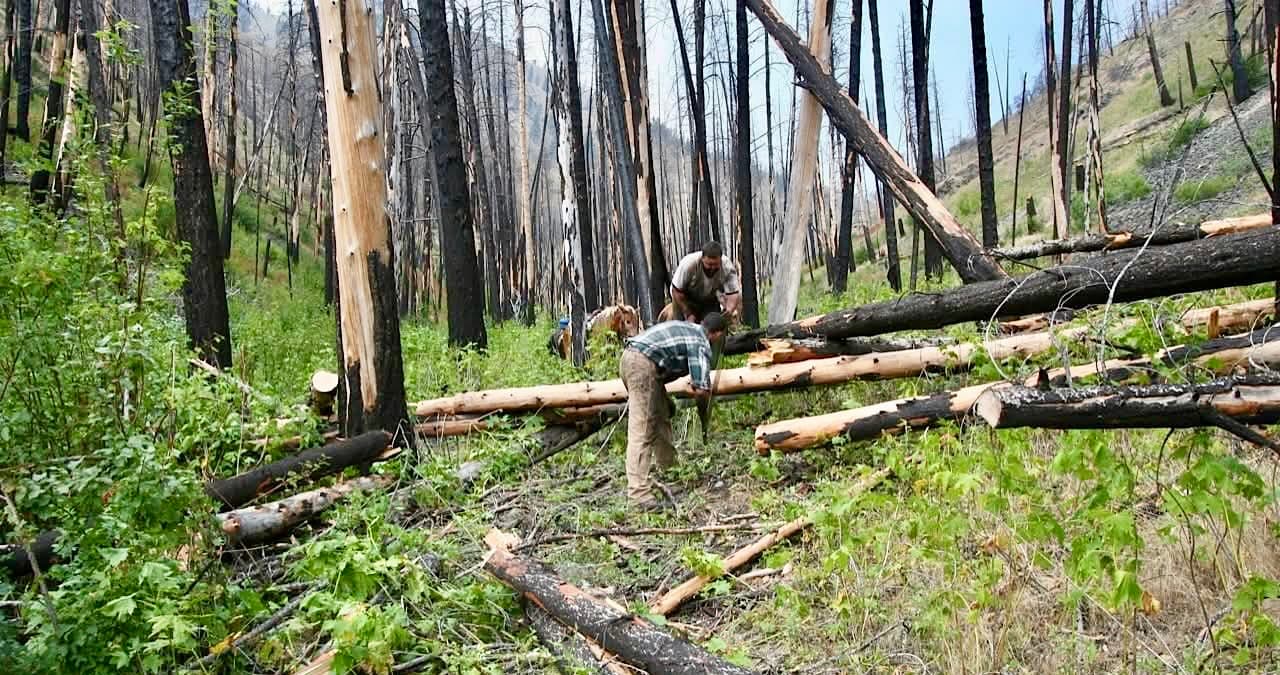
The Frank Church is the largest contiguous wilderness in the lower 48 states — 2.3 million acres — and its trails are in crisis. Fires, bark beetle infestations, and windfall have combined to create a backlog of deadfall across the trail system that in our current world, no amount of realistic hand-tool labor can catch up to. There is a debate to be had about why this is, but it's hard to deny where we are.
-
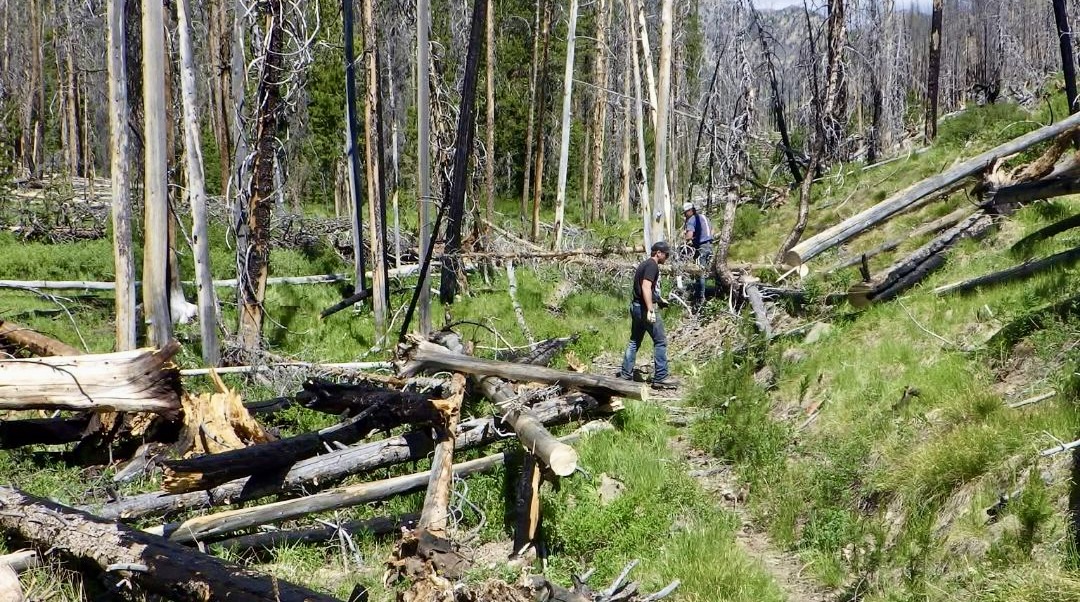
The Forest Service's October 2025 helicopter reconnaissance documented between 80,000 and 110,000 downed trees across just 150 of the 542 miles IOGA identified in the Salmon-Challis. Extrapolated across the full system, the scale is staggering and unprecedented.
-
Roughly 44% of the Salmon-Challis National Forest's trail miles in the Frank — approximately 542 miles on 61 trails — are effectively impassable. These are not degraded trails. They are blocked trails disappearing over time.
-
Increased funding and volunteer capacity since 2016, including Great American Outdoors Act dollars, have produced only marginal gains. Crews re-clear the same trails each year while new deadfall accumulates on trails not cleared, making the backlog worse.
THE LAW IS ON OUR SIDE
The Central Idaho Wilderness Act of 1980 (Public Law 96-312), the Frank Church's own enabling legislation, uses the word shall when directing the Secretary of Agriculture to clear trail obstructions annually. This is a legal obligation, not a best effort, yet it has not been fulfilled in recent years.
“In administering the River of No Return Wilderness, the Secretary shall, to the maximum extent practicable, consistent with the management plan required by this section, clear obstructions from all of the national forest trails within or adjacent to the wilderness on at least an annual basis.”
The House Report accompanying the Central Idaho Wilderness Act of 1980 is similarly explicit: the Committee recognized this was a large task and stated it had no objection to the use of chainsaws or other mechanized equipment to perform trail maintenance, as long as such use occurs in seasons and areas that do not adversely affect wildlife, disrupt natural plant succession, or create unnecessary conflicts with primitive recreational use. In the analysis of the CIWA the record says, “Subsection 4(b): Directs the clearing of obstructions from all national forest trails within and adjacent to the wilderness on at least an annual basis.” The above comment has the following footnote,
“The Committee recognizes that this is a relatively large task, and observes that the Secretary can contract with outfitters and other third parties to perform such work. The Committee has no objection to the use of chainsaws or other mechanized tools to perform such tasks, as long as such uses occur in seasons and areas where use of such equipment will not adversely affect wildlife utilization, disrupt natural process succession, or create unnecessary conflict with primitive recreational use." H.R. Rep. No. 96-838, at 19 n.1 (1980).
House Report 95-540, accompanying the Endangered American Wilderness Act of 1978, also established clearly that trail maintenance in wilderness can include the use of mechanical equipment where appropriate and/or necessary.
“Trails, trail signs, and necessary bridges are all permissible when designed in keeping with the wilderness concept. These are often important to the recreational access and use of a wilderness area. Trail construction or maintenance can include the use of mechanical equipment where appropriate and/or necessary.” H.R. Rep. No. 95-540, at 6 (1977).
On July 3, 2025, the President signed Executive Order 14313. The order states that "neglect of routine maintenance" on federal lands requires action, notes that the Forest Service carries more than $10.8 billion in deferred maintenance that has left roads and trails in disrepair, and directs federal land managers to "expand access to public lands and waters for recreation, hunting, and fishing."
The Payette National Forest's Minimum Requirements Analysis cites Executive Order 14313 as one of the federal requirements supporting action to clear the wilderness trail system, alongside the Central Idaho Wilderness Act's direction that the Secretary clear trail obstructions annually to the maximum extent practicable.
WHAT THE AUTHORIZATION ENTAILS
-
Under the terms of the MRA and subsequent authorizations, the Payette and Salmon-Challis National Forests will permit the use of chainsaws on a defined list of trails, prioritized using 20 years of fire history and insect/disease impact data, to a limited group of experienced users for the purpose of clearing catastrophic deadfall from over 1000 miles of trail.
-
The request is limited to a specific three-year window, and restricted to the period from January 1 through August 1 each year — outside of peak trail use season.
-
This is not an open-ended action. It is not a request to industrialize wilderness or to open the Frank to mechanization. It is a limited response to a documented, measurable, and severe problem. We must open these trails, or lose them.
CHAINSAWS ARE LEGAL, EFFECTIVE, AND NECESSARY
-
In order to evaluate our requests, the Forest Service conducted a formal Minimum Requirements Analysis (MRA) — the legal process the Wilderness Act requires for any use of restricted equipment. That analysis studied hand tools, battery-powered chainsaws, and gas-powered chainsaws.
-
The Forest Service's MRA concluded that gas-powered chainsaws are the minimum necessary and operationally viable tool. Their analysis found that battery-powered chainsaws are unlikely to be effective given the volume of deadfall, the remoteness of the terrain, and the limitations of battery life and solar charging at extended wilderness deployments. This is the agency's own conclusion, reached through its own analysis, signed off through the appropriate chain of command.
-
Outfitters and guides care first and foremost about outcomes for the public and for the resource. We are not committed to any one course of action, but we are motivated to find new ways to solve existing problems, instead of simply complaining about them. We believe that this authorization is the appropriate approach to solve this backlog problem, and one that will place much of the actual burden of work on our members.
ACCESS MATTERS FOR WILDERNESS
Wilderness does not exist in a vacuum, and places that no one can access cannot build the constituency needed to protect themselves. The guides, hunters, anglers, and backcountry travelers who depend on a functional trail system in the Frank Church are the same people who have shown up for this place for generations. IOGA has been involved in defending and advocating for public lands and wilderness since before the Central Idaho Wilderness Act passed in 1980. In fact, former IOGA President Norm Guth played a key role during the campaign for a Wilderness around the Salmon River, even going so far as to guide President Jimmy Carter on the Middle Fork in 1978, which the President cited as one of the best experiences of his political career when signing the Frank into law. Our commitment to the Frank Church is one of long-term, loving stewardship, and we strive to continue that legacy. Clearing trails is conservation. We want to pass this place on in a condition where the next generation can access it, and through that transformative experience, become advocates.
We are not arguing chainsaws belong in every wilderness. This proposal is specific to the Frank Church, to a defined list of trails, and to a restricted time window.
We are fighting for wilderness values, not arguing against them. Impassable trails undermine wilderness values, particularly the outstanding opportunities for primitive recreation that the Wilderness Act and the Frank's enabling legislation both protect.
We take seriously concerns about mechanization of Wilderness. That is exactly why the Forest Service's own minimum requirements process exists, and why we engaged it rather than circumventing it.
FAQ's
Q: What IOGA actually asked for?
IOGA submitted a formal proposal to the Forest Service requesting authorization to use gas-powered chainsaws to clear trails on a specific, data-supported list of 61 trails — approximately 542 miles — in the Salmon-Challis National Forest portion of the Frank Church River of No Return Wilderness. The request is limited to authorized workers (licensed outfitters and Forest Service crews or contractors), restricted to January 1 through August 1 each year, and capped at a three-year period. It is targeted at a documented backlog of deadfall, not a blanket request for mechanized access in perpetuity.
Q: Where is this happening?
Q: Where is this happening?
The Frank Church is divided among five National Forests, and the current authorizations cover two of them. On the Salmon-Challis National Forest, on the eastern side of the wilderness, chainsaw use is permitted on a defined list of trails selected from fire history, insect and disease data, and aerial reconnaissance — you can view the full list of trails and maps for the North and South zones. On the Payette National Forest, which manages roughly a third of the wilderness, chainsaw use is authorized on 57 trails identified using the same fire and insect/disease data.
Q: How bad is the deadfall problem, really?
In October 2025, the Salmon-Challis National Forest flew helicopters over approximately 150 of the 542 miles of trail IOGA identified. They documented between 80,000 and 110,000 downed trees across those 150 miles alone. Extrapolated, that suggests hundreds of thousands of trees down across the full 542-mile corridor. Many of these trails are not just difficult — they are functionally impassable for hikers, stock users, and hunters. Over time these trails are disappearing .
Q: Why can't hand tools do the job?
The Forest Service increased funding and volunteer capacity starting in 2016 — including Great American Outdoors Act dollars — and their own analysis shows that trail maintenance totals have barely budged. Trees continue to fall faster than hand-tool crews can clear them. The agency's Minimum Requirements Analysis found that hand tools simply cannot keep pace with the rate and volume of deadfall on these trails. If the backlog is solved, then a conversation about on-going maintenance is very different.
Q: Why not battery-powered chainsaws?
Battery-powered chainsaws were seriously evaluated as Alternative 3 in the Forest Service's Minimum Requirements Analysis. The agency concluded they are not operationally viable for the Frank Church's conditions. With average deadfall estimated at 500 to 700 trees per mile across 542 miles, clearing operations require sustained, multi-day cutting in extremely remote terrain. A single battery runs for 15 to 45 minutes before it needs recharging. Solar charging in remote wilderness cannot sustain the pace of work required. Carrying enough battery packs and charging equipment by pack stock would consume carrying capacity needed for food, safety gear, and other essentials. Additionally, it would lead to larger pack strings, and more traffic on trails, increasing impacts in other ways. The agency concluded it is unlikely that battery-powered saws could clear enough deadfall to meaningfully restore trail access within the three-year window.
Q: Isn't IOGA just doing this to benefit outfitters commercially?
IOGA members do operate in the Frank Church, and blocked trails directly affect their businesses. But the hundreds of miles of identified trails carry hikers, hunters, backpackers, and stock-supported families who are not commercial clients. Some of these trails are not used at all by outfitters. The Frank Church belongs to all of us. The legal obligation to clear these trails belongs to the Forest Service regardless of whether outfitters are involved. IOGA's participation in the fee-offset trail stewardship program means our members are part of the workforce that will do this work — at no direct out of pocket cost to the agency.
Q: What is the argument against this?
Critics have characterized this as commercial outfitters seeking to run chainsaws unrestricted and recklessly through wilderness. We believe that framing misrepresents both our proposal and the Forest Service's analysis. IOGA initiated a lawful process, the agency ran that process, and the agency's own analysis reached the same conclusion we did. We respect the role of wilderness advocacy organizations and take the underlying values seriously, which is exactly why we engaged the formal minimum requirements process rather than seeking to bypass it. We were here advocating for the creation of the Frank and we will be here advocating to protect it for generations to come.
Q: What happens to the Frank if these trails aren't cleared?
The trail network continues to degrade. Crews reclear the same short sections each year while the interior becomes increasingly unreachable. Hunters, hikers, and backcountry travelers lose access to one of the most remarkable wild places in North America. Solitude becomes harder to find as users are reduced to smaller areas within the vast wilderness they should be able to access. The constituency that has always fought to protect the Frank, built through generations of direct experience with this landscape, slowly erodes. Wilderness that cannot be experienced will not be defended.
Watch Outfitter and Guide Podcast interview with IOGA E.D. Erik Weiseth discussing what IOGA proposed and why.
The interview on Chainsaw use in the Frank Church River of No Return Wilderness starts around minute 12, so you can forward to that point for this conversation.