
Roadless Rule rescission: where it matters—and where it doesn’t—for Idaho
Originally published September 2, 2025. Updated August 19, 2026 to reflect the Forest Service's proposed rule and draft environmental impact statement.
What's happening (in brief)
On August 18, 2026, the Forest Service filed a proposed rule to rescind the 2001 Roadless Area Conservation Rule in its entirety, along with a draft environmental impact statement. Both are publishing in the Federal Register this week, opening a 30-day comment period that closes at midnight on September 21, 2026. Comments go through Regulations.gov, and the Forest Service is posting supporting material on its Roadless Areas page. A final rule and record of decision are expected late this year.
This is the next step in a process that began with USDA's June 2025 announcement and the August 2025 Notice of Intent, followed by a first comment period that closed September 19, 2025. The agency evaluated three paths — leave the rule in place, modify it, or rescind it outright — and proposed the third.
Two things about the numbers, because the coverage has been inconsistent:
- The rule now covers roughly 44 to 45 million acres, not 58.5 million. The 2001 figure you'll still see quoted is the original scope. Idaho and Colorado have since moved to state-specific rules, which is why the acreage under the national rule is smaller today. The rescission targets what's left.
- The Forest Service's own economic analysis is modest. The agency estimates rescission would make about 4.8 million acres newly available for timber harvest, raise national forest timber output by 5 to 10 percent, and increase industry revenue by $4.6 to $10.6 million a year. Harvest levels would still be governed by forest plans, agency budgets, and markets.
USDA's stated rationale is wildfire: more than 40 percent of inventoried roadless areas have high or very high wildfire hazard potential, only 5 percent have received hazardous fuels treatment since 2014, 11.3 million acres already sit near existing roads, and 9.8 million acres overlap the wildland-urban interface. While the Roadless Rule may have presented an additional hurdle to fuels treatments, this is likely more related to budgets, staff capacity, and the inherent remoteness of many Inventoried Roadless Areas. Additionally, roads are themselves a leading source of human ignitions, and that new road mileage adds to the maintenance obligation and wildfire risk level the agency already can't meet.
Idaho is still carved out — and now it's explicit
USDA's announcement states it directly: the proposed rule does not apply to national forests in Colorado and Idaho, because those lands are governed by separate state-specific roadless regulations. That's the same answer USDA gave informally in June 2025, now on the record in the rulemaking itself.
Idaho's rule was adopted in 2008 under then-Governor Jim Risch after a two-year state petition process, and it has been upheld in court. It maps roughly 9.3 million acres across 250 Idaho roadless areas and assigns five management classifications on a sliding scale of restrictions on road construction and timber harvest:
- Wild Land Recreation
- Special Areas of Historic or Tribal Significance
- Primitive
- Backcountry/Restoration
- General Forest/Rangeland/Grassland
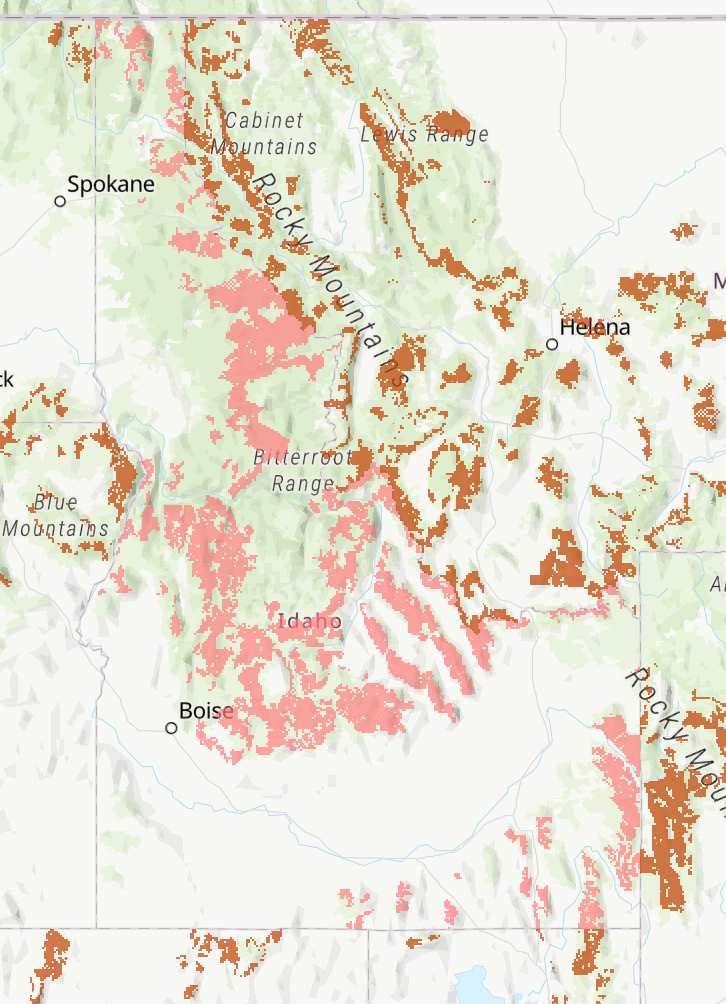
Inventoried Roadless Areas under the 2008 Idaho Roadless Rule are in pink. IRAs under the 2001 Rule, subject to the rescission, are in orange.
Click here for an interactive map of Inventoried Roadless Areas
One caveat worth keeping in mind: the Idaho Roadless Rule is itself a federal regulation (36 CFR Part 294, Subpart C), not a statute. It's durable because the coalition behind it — counties, tribes, timber, mining, conservation groups, and the outfitting industry — has held for nearly two decades, not because it's set in stone. Nothing in the current proposal touches it. But "Idaho is exempt" is a statement about this current rulemaking, not a permanent guarantee, and IOGA will keep watching accordingly.
A reality check on pace and scale
Outdoor writer Wes Siler made an argument last year that has held up reasonably well: the practical constraint on road building isn't the rule, it's money. The Forest Service manages roughly 386,000 miles of existing road and carries a deferred maintenance backlog now estimated above $10 billion. New road construction costs in steep, remote country like many of these places are astronomical. An agency that cannot maintain the current roads will not be positioned to build many new ones quickly, and staffing reductions have not improved that math.
Add to that the procedural reality: rescission removes a nationwide prohibition. It does not authorize a single road at this time. Every project still runs through the relevant forest plan and site-specific NEPA analysis, and litigation over the final rule is a near certainty.
The counterweight to all of that: roads are effectively permanent. A budget constraint can be lifted in a single appropriations cycle; a road cut into a headwaters drainage cannot be un-cut. The realistic near-term impact is small. The realistic long-term impact depends on decisions that haven't been made yet — which is precisely why this matters and the forest-plan and project-level decisions are so critical to follow.
Cross-border watch list
Because Idaho keeps its state rule, direct in-state change should be minimal. But many Idaho outfitters work close to state lines or depend on watersheds that cross them. Roadless acreage under the national rule is concentrated in ten Western states, with Alaska holding close to a third of the total; Montana, Oregon (1.9 million acres), and Washington (2 million acres) all border or feed into country Idaho operators use.
Fish and wildlife don't follow state lines. Outfitters and guides rely on connected, healthy habitat to support big game populations, fisheries, and quality outdoor experiences. New road development outside Idaho could still fragment habitat and degrade watersheds that extend into the state — and roads are a major driver of wildfire ignition, with Forest Service lands near roads seeing ignition rates roughly four times higher than roadless or wilderness areas, according to a 2025 analysis.
The geographic hotspots for Idaho outfitters to monitor are any of those contiguous ecosystems that cross state borders:
- Bitterroot crest & Clearwater headwaters (Idaho–Montana)
- Palisades/Greater Yellowstone (Idaho–Wyoming)
- Cache National Forest (Idaho-Utah)
- Hells Canyon & Blue Mountains rim (Idaho–Oregon)
- Selkirks & Salmo-Priest country (Idaho–Washington)
- Kootenai & Kaniksu National Forests (Idaho - Montana)
In each case, nothing happens automatically. Any change still moves through that forest's plan and NEPA.
Practical takeaways for Idaho outfitters
-
Stay the course under Idaho's rule. Day-to-day operations in Idaho roadless areas continue under our own classifications and associated regulations. Business as usual. However…
-
Cross-border vigilance matters more now, not less. With a final rule expected before year's end, the action shifts to neighboring forests' plan direction and project scoping in IRAs immediately across state lines. Early comments shape forest planning, project permitting, and watershed protection.
-
For land-based outfitters, rescission could lead to fragmentation and development in larger connected habitats across state lines. For river-based outfitters, the most realistic indirect impacts come from sediment and temperature effects originating upstream and out of state, not from a sudden spike in development.
-
Public perception is an asset. Idaho's intact roadless settings under the 2008 rule are a real differentiator for clients seeking remoteness and wildlife security. And as the national rule goes away, Idaho's rule stands as the working example of flexible, locally negotiated management that other states may look to.
Comment by September 21
The comment period on the proposed rule and draft EIS is open now and closes at midnight on September 21, 2026, at Regulations.gov. Comments that describe specific operational, economic, or resource effects — named drainages, named permits, documented client experience — carry more weight in the record than general opposition or support. IOGA members who want help framing a comment should contact the office.
Bottom line: Idaho's 2008 Roadless Rule still governs in-state lands and is not part of this proposal, so day-to-day operations here don't change. The federal rescission is now in its final procedural stretch, and the agency's own numbers suggest a gradual rather than immediate shift. The place to spend attention is neighboring states, where forest plan and project decisions over the next several years will shape the watersheds, wildlife, and backcountry character Idaho outfitters depend on.