
The Salmon-less River: We Were Promised Fish. We Got a System That Cannot Deliver.
I've spent the last seven years rowing boats on the Salmon River, from the headwaters of the Middle Fork down to the confluence with the Snake. Idaho holds the highest, coldest, most intact salmon habitat left in the lower 48. What we don't have, in most of it, is salmon.
That's not just heartbreaking to watch. For a lot of Idahoans, it's putting their living at stake. The outfitters and guides who run anadromous fishing trips in this state depend on hatchery returns to put clients on fish. When adults come back in numbers, there's a season, there's harvest, and there's a business. When they don't, the fishery closes, the trips get canceled, and the money that would have flowed into towns like Riggins, Salmon, and Orofino never shows up. Our industry is built on the promise that these fish will return. Increasingly, they don't.
There's a study out this spring that explains why, in language even the agencies running our hatcheries can't argue with. It deserves a closer look than a newspaper column can give it, so here is the longer version — because a hatchery system that can't meet its goals isn't an abstraction to the people who guide these rivers. It's a threat to how we make a living.
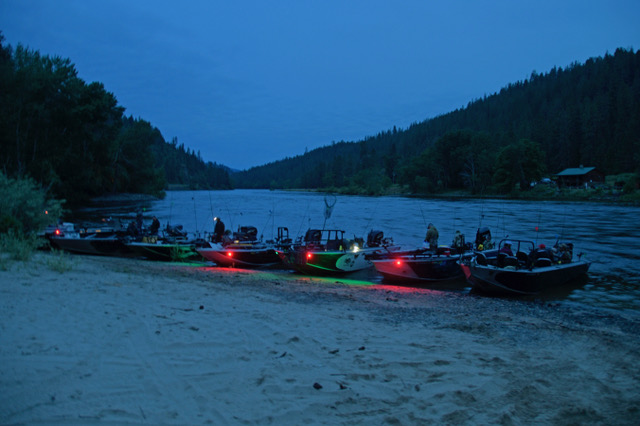
Salmon fishing guides line up on the Clearwater, ready for a day on the water with clients. The spring season was abruptly closed that morning.
The promise that came with the concrete
When the federal government built four dams on the lower Snake River, and Idaho Power built three in Hells Canyon, they knew it would have a negative impact on fish but they promised real mitigation to maintain our heritage by funding hatcheries. Congress authorized the Lower Snake River Compensation Plan in 1976 to do this. Idaho Power signed a settlement in 1980 committing to the same.
Putting aside the very real differences between hatchery and wild salmon, the fact remains that many people in the basin, especially guides, families, and tribal anglers, rely on hatchery fish for their harvest opportunity, livelihood, and culture. Those obligations are, in large part, the reason Idaho accepted the dams in the first place. Fifty years later, it’s fair to ask whether the promise was kept.
What the study found
This spring, biologists from Idaho Fish and Game, Oregon Fish and Wildlife, and Washington Fish and Wildlife published an evaluation of ten Snake River spring and summer Chinook hatchery programs in the North American Journal of Fisheries Management. It's worth being clear about who these people are. They are the agencies that run the hatcheries. The work was funded by the Bonneville Power Administration, the U.S. Fish and Wildlife Service, and Idaho Power — the entities that pay for the mitigation. Nobody in that group had any reason to make the system look worse than it is.
Their conclusion, in their own words: these programs "have not achieved mitigation goals in almost 40 years of program development, reform, and maturation." Across 177 hatchery releases they examined, adult return goals were met only 21 times. Four of the ten programs — Kooskia, Pahsimeroi, Sawtooth, and Tucannon — never once hit their goal in the years studied. Overall, they write:
"Our analysis demonstrates that goals cannot be achieved under current conditions with the existing hatchery system."
And this isn't only about the big mitigation targets. When the authors lowered the bar to simply ask "can this program support a minimal recreational fishery," they found that less than half could reliably do even that under current survival rates.
The failure is downstream, not in the hatchery
Here's the part that should reframe the whole debate in Idaho. The hatcheries themselves are not the problem.
Our hatchery managers do their job. The study measured smolt survival from release down to the first dam below Lewiston, and for most programs that number runs between 55 and 80 percent. (One program, Catherine Creek in Oregon, sits lower at about 36 percent, but the Idaho programs largely fall in that upper band.) Those are respectable numbers. The fish leave the hatchery healthy and most of them reach the top of the hydrosystem alive.
Then they enter the dams, and the arithmetic falls apart.
A smolt leaving an Idaho hatchery has to pass eight federal dams on its way to the Pacific, survive the estuary and the ocean, and then climb all eight of those dams again as an adult coming home. The share that completes that entire round trip is called the smolt-to-adult return rate, or SAR. It is the single number that decides how many adults come back for broodstock and for harvest.
When the Compensation Plan was designed, production goals were set on the assumption that, on average, 0.87 percent of smolts would return as adults. The real figure, measured over the last two decades, is 0.36 percent — less than half of what the entire system was built around.
Put it in plain terms. For every 1,000 smolts we pay to raise and release, the plan's goal was 8.7 coming back. Lately we're lucky to get 3.7 returning per 1,000 smolts.
Why "just build more" doesn't work
The instinct, once people see those numbers, is to make more fish. If only a third come back, raise three times as many. The study looked at that strategy, and it’s just not realistic.
To meet adult return goals at current survival rates, these programs would need to increase smolt production by 300 to 1,200 percent depending on the hatchery. Four of them — Kooskia, Tucannon, Sawtooth, and Pahsimeroi — would need increases at or near 800 percent or more.
|
Hatchery program |
Observed SAR |
SAR needed to meet goal |
Production increase needed |
|
Clearwater |
0.32% |
0.57% |
369% |
|
Rapid River |
0.39% |
1.36% |
527% |
|
Dworshak |
0.36% |
0.84% |
541% |
|
McCall |
0.59% |
1.57% |
664% |
|
Catherine Creek |
0.46% |
2.71% |
664% |
|
Imnaha |
0.53% |
1.13% |
723% |
|
Sawtooth |
0.29% |
2.58% |
793% |
|
Tucannon |
0.14% |
1.32% |
834% |
|
Kooskia |
0.12% |
0.90% |
956% |
|
Pahsimeroi |
0.09% |
2.33% |
1,169% |
Source: Ebel et al. 2026, Table 2. "Production increase needed" assumes recent survival rates hold.
Those aren't adjustments. They're fantasies. Hatcheries have finite water, finite space, and finite budgets, and the authors say so directly. Worse, the study notes that cramming more fish into the same facilities eventually drives survival down through competition and disease — meaning the real increases required would be even larger than the table shows. The authors call their own numbers conservative for exactly this reason.
And that's before the bill arrives. Increasing smolt production at that level would be immensely expensive, requiring new infrastructure, water supply, staffing, and years to complete. Already, the Compensation Plan's own planning documents show hundreds of millions of dollars in unfunded deferred maintenance — failed water lines, 40-year-old raceways, intakes out of compliance — just to keep the current facilities standing. On top of that, the US Fish and Wildlife’s capital planning identifies roughly $248 million in additional projects in an attempt to hit mitigation goals. Every dollar of it comes from taxpayers and Northwest electricity ratepayers. We would be spending a fortune to expand a system that its own operators have shown cannot meet its targets.
A fishery built on a subsidy is a fishery that can be canceled
There's a deeper problem with hitching Idaho's salmon fisheries to hatchery production, and it has nothing to do with biology. It's that the whole arrangement runs on government money, and government money is not guaranteed.
We got a live demonstration this summer, one state over. In June, the Bonneville Power Administration — the same agency that funds much of the mitigation in our basin — notified Oregon and Washington that it would end its share of funding for the Select Area Fisheries Enhancement program, or SAFE, effective September 30, 2026. SAFE has operated in the Lower Columbia since 1993. It raises millions of salmon that support commercial and recreational fisheries, and in 2025 those fish contributed around $6 million to regional fishing communities. Running the program costs about $2.4 million a year, and BPA had historically covered roughly $1.6 million of that — two-thirds of its operating costs. The agency gave about three months' notice, and state managers warn the loss puts more than 7 million hatchery fish, most of them mid-production, at risk.
The reason BPA gave for terminating the program should stop every Idaho angler cold. The agency said it was pulling out because the program "has not made sufficient progress toward improving populations of salmon protected under the Endangered Species Act." That's a different yardstick than the one our hatcheries are measured against — SAFE was judged on helping recover ESA-listed stocks, while the Lower Snake River Compensation Plan exists to replace lost harvest, not to recover listed fish. But the posture is what matters here. A federal funder looked at a decades-old hatchery program, decided it wasn't delivering the benefit it was paying for, and walked away with one letter and one budget cycle's notice. The study you just read documents a comparable shortfall in our basin against our own goals — programs that have not met their mitigation targets in nearly 40 years. If underperformance is grounds for a funder to walk, our programs are not obviously safer than Oregon's.
I'm not drawing a straight line from SAFE to Rapid River. SAFE is a different kind of program in a different part of the basin, and Idaho's mitigation hatcheries rest on different legal obligations. Oregon's congressional delegation and a bipartisan group of coastal lawmakers are fighting to reverse the cut, and they may succeed. But the lesson holds regardless of how that fight ends. A fishery that depends on an annual federal appropriation is a fishery that exists at the discretion of whoever controls that appropriation. It can be trimmed, delayed, or ended for reasons that have nothing to do with the fish and everything to do with a budget. Our industry has quietly bet its future on that money continuing to flow, year after year, in a political climate that no longer guarantees it.
A fishery built on self-sustaining wild runs would not be that fragile. But wild runs can't rebuild while the dams impose the very mortality that pushed us into hatcheries in the first place. The subsidy and the wild run come up short for the same reason, and the reason is downstream.
"We're not asking for a miracle. We're asking for what river communities deserve: abundant, resilient salmon runs returning to Idaho."
We watched returns fail in real time this spring
If that all sounds abstract, look at what happened with the Clearwater fishery earlier this year — because the Clearwater is the best program in that table, the one that needs the smallest production increase to hit its goal.
The season opened on a projected harvest share of about 2,000 adult Chinook. Then the fish stopped showing up where they were supposed to. Salmon normally convert from Ice Harbor Dam up to Lower Granite at around 95 percent; this spring that rate fell to roughly 87 percent, and Fish and Game says nothing like it has been documented in the 30 years they've managed these fisheries under the current framework. The projected harvest share collapsed from 2,000 to about 1,000. Managers had set the season to take 1,100 to 1,200 fish and did exactly that — but the run underneath that harvest came up short, so the lower Clearwater closed on May 19 and more closures followed. The state and the Nez Perce Tribe then had to lower hatchery goals to make the books balance.
This wasn't a case of anglers taking too much. Fish and Game set a fishery to catch what the forecast promised and hit their number almost exactly. The fish simply weren't behind it. Our best-performing program, in a below-average year, couldn't keep a fishery open past mid-May — because far fewer fish than expected converted from Ice Harbor Dam up to Lower Granite Dam, and Fish and Game still can't say why. Whatever the cause, it happened in the river below Idaho, in the stretch that runs through the four lower Snake dams. That is the same downstream stretch the study points to, and it is the stretch no hatchery can reach.
The number that actually matters
At the end of the day, the figure that means anything to an Idahoan isn't how many smolts we release. It's how many adult salmon come home. We have spent fifty years and a great deal of public money optimizing the first number while the second one stayed broken, because the thing breaking it sits downstream of everything a hatchery can control.
The study's authors stop short of specific policy recommendations — that's not their job. But they say plainly that improving survival through the migration corridor, especially the dammed stretches, is the likeliest path to meeting goals, and that the dam system and the way it's operated may be working against the very programs built to compensate for it.
In simple terms: we cannot grow enough fish in Idaho to solve this if they keep dying between here and the ocean at the rate they die now.
Where this leaves us
Add the numbers up and they all point in one direction. Our hatcheries release healthy smolts — 55 to 80 percent of them reach the first dam alive. The plan was built assuming 0.87 percent would come back as adults; we get 0.36. No program in the study can close that gap by making more fish without a 300 to 1,200 percent production increase that the water, space, and money simply do not allow. And the money we do spend is both enormous and fragile — hundreds of millions in deferred maintenance, a quarter-billion-dollar capital wish list that still falls short, and a funding stream that BPA just proved it will cut with three months' notice when it decides a hatchery program isn't delivering.
Every one of those facts traces back to the same place: the corridor between Idaho and the ocean, and the eight federal dams a fish has to survive twice to complete its life. The four lower Snake dams sit at the center of it. They are the stretch where our best program lost the fish it was counting on this spring, in a decline Fish and Game says it has never seen in 30 years of managing these fisheries. They are the reason a smolt's odds collapse after it leaves a hatchery doing everything right. And they are the one variable in this entire system that a hatchery cannot touch, no matter how much we spend on it.
The study says it plainly: the dam system and the way it is operated may be working against the very programs built to compensate for it. Improving survival through that corridor is the only lever left that moves every program at once — hatchery fish and wild fish, this year's return and the next decade's. In the near term, that means operating the hydrosystem for fish: faster passage, cooler water, more spill where the evidence supports it, whatever it takes to get juveniles to the ocean and adults back home alive. It also means confronting what the dams have done to the predator balance in the river. The slackwater reservoirs behind the dams are ideal habitat for walleye and bass, whose populations have climbed while salmon have fallen, and the dams concentrate juvenile salmon at predictable choke points where birds — terns and cormorants — and non-native fish pick them off. Downstream, sea lions have learned to stack up at the tailraces and fish ladders and feast on adults trying to climb home. None of this happened by accident; it is the river the dams created. Serious predator management, from the reservoirs to the estuary, is part of restoring the survival the mitigation system was supposed to deliver. In the long term, it means Idaho has to stop treating the lower Snake dams as permanent fixtures beyond question, and start honestly weighing what they produce against the fishery, the heritage, and the livelihoods they continue to cost.
Idaho's outfitters and guides have watched this unfold now for a generations. We're not asking for a miracle. We're asking for what river communities deserve: abundant, resilient salmon runs returning to Idaho. And we're asking that we stop pouring money into a failing system and start fixing the stretch of river that is actually killing these fish.